
A soft-dried fruit MOQ private label discussion is often treated as a single-number question. For a first order, it is better understood as a planning conversation. The buyer needs to define the product, pack, market, approval route, and demand assumption before a manufacturer can judge whether a proposed run makes operational sense.
Instead of collecting figures that may describe different products or packaging setups, ask each supplier to respond to the same brief. This guide explains the variables, decision gates, and questions to prepare for an early sourcing call.
Start with the order frame, not the minimum
Before asking about a minimum, write down what the first order is meant to prove. Is it a product launch, a retailer test, an ingredient trial, or a replenishment plan?
State the destination market, sales channel, expected timing window, and whether the order is a one-off evaluation or part of a repeat-buying plan.
The goal is a clear, adjustable brief—not a universal commitment.
The soft-dried fruit MOQ private label variables to map
A useful first-order brief separates the decision into connected variables. Changing one may change the practical minimum for the others.
Product definition
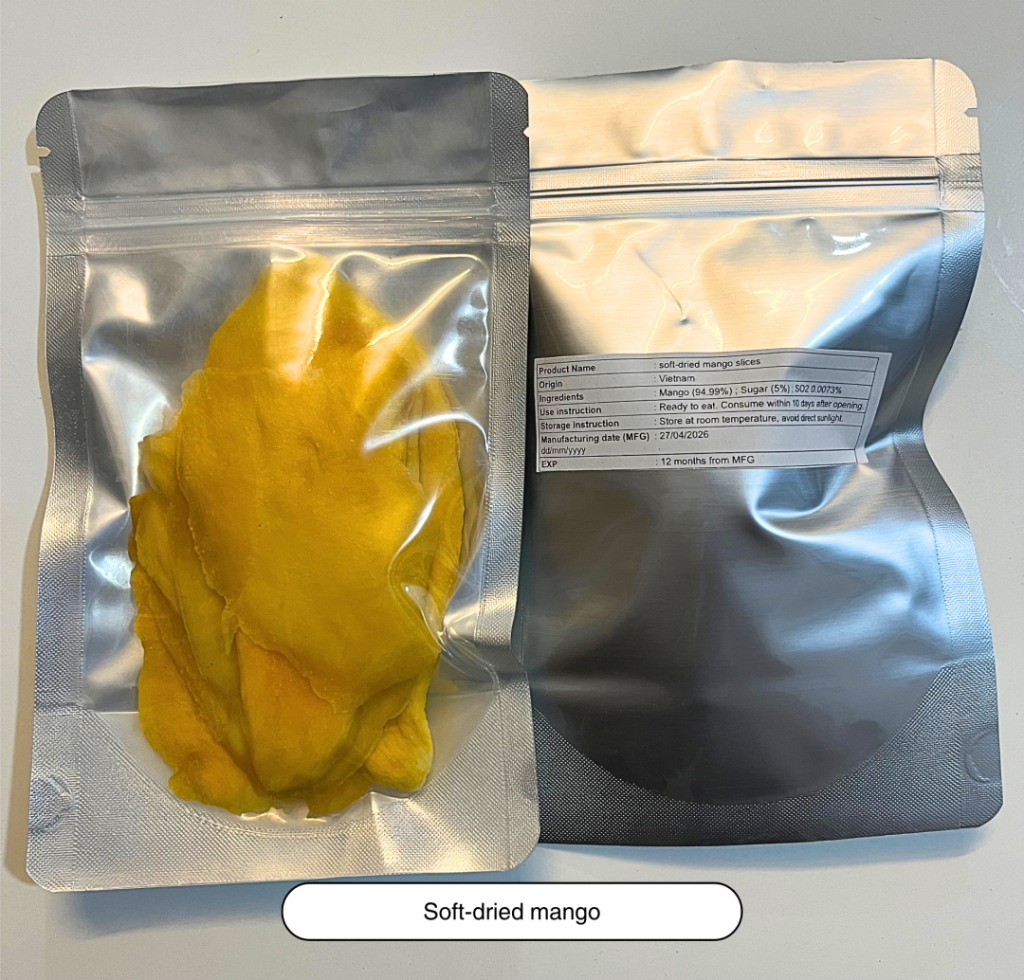
Name the fruit, cut or piece style, texture expectation, sweetness position, ingredient expectations, and any flavour or blend requirement. “Soft-dried mango” can still mean different specifications to different buyers. A clear definition prevents an MOQ discussion from being based on an assumed product.
Packaging format
Record the pack type, fill weight, number of units per outer case, label language, and whether you need a standard pack or a new private-label configuration. Packaging is not a cosmetic detail. It can affect materials, artwork, print setup, packing method, and the decisions that need approval before production planning.
Brand and artwork readiness
Say whether artwork exists, is in review, or has not started. If you have a design agency, identify who will approve technical copy, nutrition information, legal wording, and print proof. If you do not, flag that early rather than treating labels as a final-week task.
Destination-market requirements
Tell the supplier where the product will be sold and who holds responsibility for market checks. Ask which product and packaging information the supplier needs in order to assess the request. Do not assume that an answer for one market, buyer, or distribution route transfers automatically to another.
Demand and ordering pattern
Share the most realistic demand assumption you can support: expected launch volume, sell-through evidence if any, stock-holding limits, and the point at which you would consider repeating an order. A forecast is not a promise. It gives both sides a basis for deciding whether the first order should be structured as a test, a launch, or part of a longer procurement plan.
Operational constraints
List your delivery destination, preferred Incoterm if already decided, receiving capacity, outer-case requirements, and internal decision deadline. These details do not determine an outcome on their own, but they prevent a later logistics or warehousing constraint from invalidating the original comparison.
Soft-dried fruit MOQ private label decision gates
A first-order plan benefits from gates: moments when the buyer decides whether to proceed, revise the brief, or pause the project. The gates keep expensive assumptions from moving forward unnoticed.
Gate one: product fit. Confirm that your written product description reflects the item you want to evaluate. If key details remain unknown, revise the brief before comparing supplier responses.
Gate two: packaging feasibility. Confirm which pack components are buyer-supplied, supplier-sourced, or still undecided. Do not approve artwork or make retailer commitments while the information needed for packaging review remains incomplete.
Gate three: market and documentation scope. Identify what your buyer, distributor, or internal team requires for the intended market. Keep this as a request for confirmation, not as an assumption that every supplier or product carries the same documentation.
Gate four: demand confidence. Compare the proposed first order with your cash, storage, channel, and replenishment assumptions. If the plan depends on a future listing, promotion, or buyer commitment that is not yet secure, record that dependency explicitly.
Gate five: commercial comparison. Only compare offers when each supplier has responded to the same product, packaging, destination, and responsibility assumptions. A lower apparent minimum can be misleading if the scope differs.
Soft-dried fruit MOQ private label questions
Use these questions in writing so that you can compare responses later:
- Which parts of this brief most affect the proposed minimum for this product and pack?
- Which specifications can remain standard, and which would require a separate production or packaging setup?
- What artwork, pack, and product information must be confirmed before the order can be assessed?
- Which destination-market assumptions are you relying on, and which must the buyer verify independently?
- If our initial demand estimate changes, which parts of the proposal would need to be reviewed again?
- What decision points should both sides document before the buyer treats the order as ready to proceed?
These questions do not seek a guaranteed commercial result. They ask the supplier to show the reasoning behind their response. That is more useful than treating a minimum as a standalone purchasing metric.
Compare soft-dried fruit MOQ private-label proposals honestly
The same phrase can hide different scopes. One response may refer only to bulk product. Another may include a particular pack format. A third may depend on artwork, materials, a destination route, or a recurring-order assumption that has not been written down.
Create a comparison sheet with one row for every agreed variable. Include product specification, packaging, artwork status, market, logistics assumptions, approvals, and open questions. Mark every blank as an unresolved item, rather than filling it with an assumption. This approach also helps internal teams see whether they are choosing a supplier, a product configuration, or a different risk profile.
Use VNPROMISE resources with the right scope
For the broader buyer journey, read VNPROMISE’s private-label manufacturing guide for EU, UK, and GCC buyers. Use it to frame the wider manufacturing and private-label discussion, then confirm project-specific facts directly with the relevant parties.
VNPROMISE also has a UK soft-dried mango buyer checklist. Scope warning: that checklist is for UK soft-dried mango buying only. Do not treat it as a general checklist for other fruits, private-label formats, or non-UK markets.
Read here for FREE BUYER CHECKLIST
DOWNLOAD BUYER CHECKLIST FOR FREE
Frequently asked questions
Is there one soft-dried fruit MOQ private label figure for every buyer?
No. A meaningful answer depends on the product, packaging, artwork, destination, demand assumption, and operational setup described in the buyer’s brief. Ask suppliers to state the assumptions behind their response.
Should I ask about MOQ before finalising my packaging?
You can begin the conversation early, but identify what is known and what remains open. Packaging choices can affect the practical assessment, so compare responses only when the scope is clear.
Can a supplier’s answer replace our own market or label review?
No. Buyers should assign responsibility for their own market, legal, customer, and label checks. Ask suppliers what information they need, but do not turn a sourcing conversation into an unverified compliance conclusion.