
For a snack brand, importer or re-packer, private label dried mango UK sourcing is not just a packaging exercise. The finished product has to match the consumer proposition, ingredient profile, pack format, pricing model and Great Britain label requirements. A strong first brief makes it easier to compare suppliers and reduces late changes after artwork or samples are already in motion.
This guide explains the decisions UK brands should make before requesting a private-label dried mango quotation from Vietnam. It is designed for retail-ready snack packs, foodservice packs and buyers planning to use dried mango as an ingredient. It is not legal advice: the UK business responsible for placing the finished pack on the market should review the final label, composition and import route before launch.
Private-label dried mango UK: Why it can fit a brand portfolio
Dried mango can work across several buyer propositions: a simple fruit snack, a better-for-you lunchbox line, a premium travel snack, a gift assortment or an ingredient for granola, bakery and foodservice. The commercial opportunity is not “mango” in general; it is selecting a product that matches the claimed eating experience and target shelf price.
Before a private label dried mango UK project moves to quotation, decide what you want the consumer to recognize on pack. Is the priority a soft texture, a clean ingredient list, a sweetened profile, a specific cut, or a value-led larger pack? Each choice changes the product brief, potential yield, pack design and commercial feasibility.
For a first launch, keep the brief narrow: one format, one pack size and one market route. This makes sampling and label review more controlled than pricing several concepts at once.
Choose the dried mango format before you choose the pack
“Dried mango” can describe very different products. A quotation is only useful when the format is clear.
Slices, strips or pieces
Slices and strips are familiar retail-snack formats. They make the fruit easy to see through a windowed pouch and can suit premium or on-the-go positioning. Diced pieces may be more appropriate for baking, cereal, trail mixes or foodservice applications. Ask the supplier to confirm the practical cut tolerance and whether the product will be packed as a whole-piece snack or used as an ingredient.
Sweetened, unsweetened or a specified recipe
Do not treat “no added sugar”, “unsweetened” and “naturally sweet” as interchangeable. The buyer should state the intended ingredient declaration and nutrition positioning, then confirm whether the selected recipe supports it. Equally, do not claim “sulphite-free” or “allergen-free” before the finished product, production controls and test requirements have been confirmed.
Texture, colour and moisture expectations
A soft-dried product should be described in measurable terms, not only with words such as “premium” or “soft.” Ask for the agreed texture profile, acceptable colour range, moisture or water-activity specification where relevant, shelf-life basis and the condition in which the product will be assessed. This matters because a product that looks right in a sample may behave differently after packing, shipping and shelf storage.
For private label dried mango UK sourcing, the soft dried mango specification should be approved before final packaging artwork is released. The label should describe the actual product—not the product concept the brand originally imagined.
Build a packaging brief that a supplier can quote
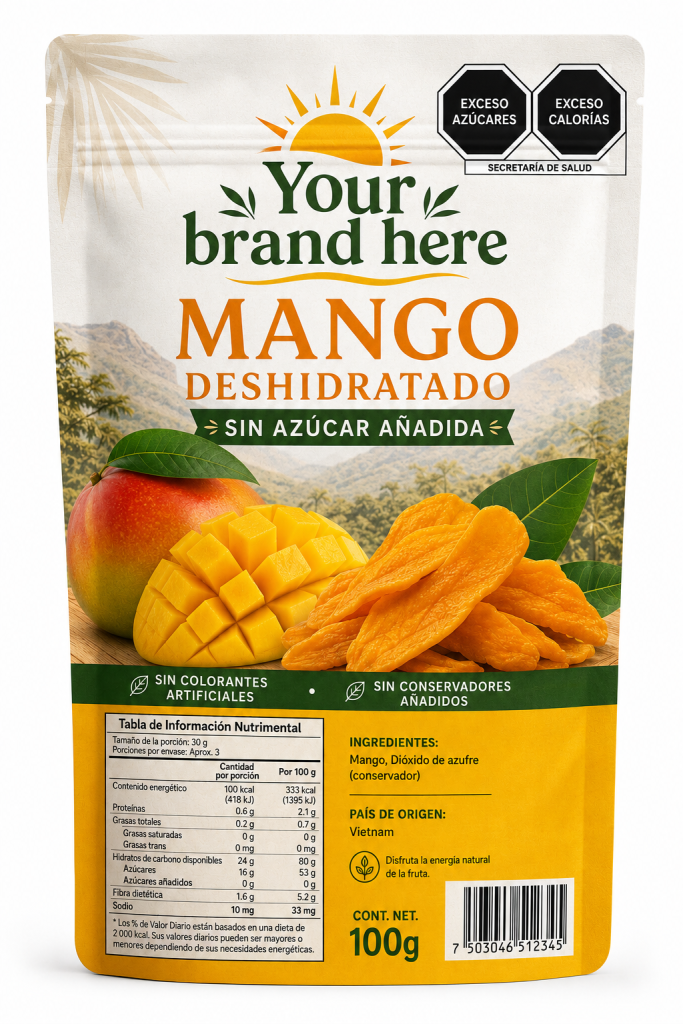
Packaging is where private label becomes commercially specific. Instead of asking, “Can you put our logo on it?”, send a brief that states the intended retail route and physical pack requirements.
Include these points:
- Pack format: stand-up pouch, flat pouch, jar, flow-wrap, foodservice bag or another format
- Net weight: for example, a single-serve snack, a sharing pack or a bulk ingredient pack.
- Material and barrier needs: whether the product needs a particular pack structure, reseal feature, transparent window or sustainability requirement.
- Artwork ownership: who supplies the print-ready artwork, who approves proofs and who owns final files.
- Carton and pallet requirements: outer-case count, barcode needs, retailer carton labels and delivery format.
- Launch route: online, independent retail, foodservice, wholesale or a named retail programme.
UK guidance says product information must be clear, permanent, easy to understand, visible and not misleading. If the business packs the food itself, packaging must also be suitable for food contact; certain materials require written compliance evidence from the packaging supplier. These are implementation checks, not claims that every proposed pack is already approved. [1]
What UK brands should confirm before approving a label
The final label is a shared responsibility between the brand, importer and supply chain. The supplier can provide product information and packaging inputs, but the UK business responsible for marketing or importing the product should ensure the final pack is appropriate for its sales route.
At a minimum, create a label-review checklist covering:
- Food name and ingredients. The product name should accurately describe the food. The ingredients list must reflect the confirmed recipe and additives, if any.
- Allergen information. Allergen treatment depends on whether food is prepacked, sold loose or prepacked for direct sale. Confirm the category before preparing artwork.
- Net quantity. Use the appropriate declared quantity and make sure it matches the product and pack actually being supplied.
- Responsible business details. Confirm the name and address details required for the business marketing the food or the importer, as applicable.
- Storage and date marking. Use the shelf-life basis and storage conditions confirmed for the finished SKU, not generic wording copied from another product.
- Nutrition, origin and claims. Check nutrition declaration requirements, country-of-origin presentation where applicable, and every “free-from”, health, organic or sustainability claim before printing.
Great Britain’s food-labelling guidance is explicit that food information must not mislead. It also differentiates requirements for loose food, food packaged on site and pre-packed products. [1] This is why a private label dried mango UK launch should follow Import Dried Mango from Vietnam to the UK: A Buyer Guide rather than relying on a previous experience from another market.
Request documents and QA information early
A private-label buyer should not wait until the purchase order to ask for quality and traceability information. Build the request into the first product brief.
Ask which documents can be supplied for the actual SKU and batch, and which need to be agreed before production. Depending on the product and route, that may include a product specification, ingredient statement, allergen statement, shelf-life basis, microbiological or residue test plan, lot-specific certificate of analysis, traceability information and packaging documentation. If a buyer needs a particular certification, organic status, sulfite limit or retailer protocol, state it at the beginning and ask the supplier to confirm feasibility in writing.
VNPROMISE should only present documentation that belongs to the approved factory and product route. A buyer should not infer that a certificate, test result or market approval applies to every SKU unless it has been confirmed for that project.
Set the commercial brief before asking for an MOQ
MOQ is not a universal number for dried mango. It can vary with the recipe, cut, pack size, printed-film requirement, carton configuration and shipment route. A very small order may be possible for an evaluation in one format but not for a fully customised retail pack with dedicated printed materials.
To receive a meaningful quote, include the expected trial quantity, target annual volume, destination, Incoterm, pack specification and required launch date. If you are comparing suppliers, use the same brief for each one. That makes it easier to identify whether a price difference comes from product composition, packaging, documentation, freight assumptions or minimum order conditions.
A practical sequence is: confirm the product concept, review sample and specification, agree packaging feasibility, complete label review, then finalise the commercial offer. This is slower than choosing on price alone, but it lowers the risk of buying a pack that cannot be used in the intended channel.
How VNPROMISE can support a UK private-label project
VNPROMISE is a Vietnam-based manufacturing and export partner for soft-dried fruit. For a private label dried mango UK enquiry, the useful first step is not a generic catalogue request. It is a concise project brief that lets the team assess product format, packaging route, documentation expectations and commercial fit with the relevant manufacturing setup.
Send the intended mango format, ingredient preference, pack size, launch route, trial and annual volume, destination and any required documentation. VNPROMISE can then confirm the appropriate next step—such as a specification discussion, sample feasibility review or project-specific quotation—without making unsupported promises about MOQ, lead time, certification or retailer acceptance.
Frequently asked questions
Can a UK brand order private-label dried mango from Vietnam?
Yes, a UK brand can explore a private-label project with a Vietnam-based supplier, but the project should start with a defined product and packaging brief. The UK business should also review the final label, import route and documentation requirements for the finished SKU.
Can I use my own branding and packaging artwork?
Usually, a private-label project requires the buyer to supply or approve brand artwork, then confirm the pack material, dimensions, print method and proofing process with the supplier. Feasibility and minimum-order conditions should be confirmed for the chosen pack, not assumed from a generic product listing.
Is dried mango automatically suitable for UK retail?
No. Retail suitability depends on the actual product, ingredient declaration, pack, label, barcode/carton requirements, testing, documentation and the retailer’s own criteria. Do not make a retailer-ready claim until those conditions are verified.
Send a private-label project brief
Ready to explore private label dried mango UK sourcing? Click here to Send VNPROMISE a short brief with your product format, ingredient preference, pack size, destination, expected volume and documentation requirements. We will review the project against the relevant manufacturing setup and advise the next practical step.
2 Responses